The sensitivity simulation capabilities uses variation in model constants to change output. In some cases it is desirable to have different noise streams in active model variables. To do this use the RANDOM… functions available in Vensim and do sensitivity search on the Constant NOISE SEED or the particular Stream ID you supplied as a parameter to the random function. This will give different noise streams on each simulation.
Background
Recall that the RANDOM functions end with a Stream ID argument. If your equation is,
my price = RANDOM UNIFORM(20,30,Stream ID) ~~|
there will be a distinct stream of random numbers for all variables that share the same Stream ID. If the Stream Id = 0, the random sequence will be controlled by the special variable NOISE SEED, which you can add to the model.
If you are using RANDOM functions with distinct noise stream IDs, you can choose to change only some of those noise streams by changing the seed argument to them. For example if you have model equations:
my price = RANDOM UNIFORM(20,30,MYSEED) ~~|
their price = RANDOM UNIFORM(20,30,0) ~~|
then doing a search over MYSEED will show the results of different values for my price with a consistent (though still random) set of values for their price.
A word of caution: if you have conditional equations like,
soda price = IF THEN ELSE(Temperature is Hot, RANDOM UNIFORM(4,6,MYSEED), 3) ~~|
variation in Temperature is Hot could cause the number of values drawn from the MYSEED stream to vary, influencing the results. If temperature is also influenced by a different random stream, this causes crosstalk between the random processes. To avoid that, you could structure this as:
soda price = IF THEN ELSE(Temperature is Hot, hot day soda price, 3) ~~|
hot day soda price = RANDOM UNIFORM(4,6,MYSEED) ~~|
By moving the RANDOM function out of the IF THEN ELSE, you guarantee that a random draw is made every time step, irrespective of temperature.
Varying NOISE SEED or other random streams by VECTOR
Best practice is to use a VECTOR distribution for NOISE SEED or other Stream IDs, where the Min and Max are integers with a range at least as great as the # Simulations, and the increment is 1.
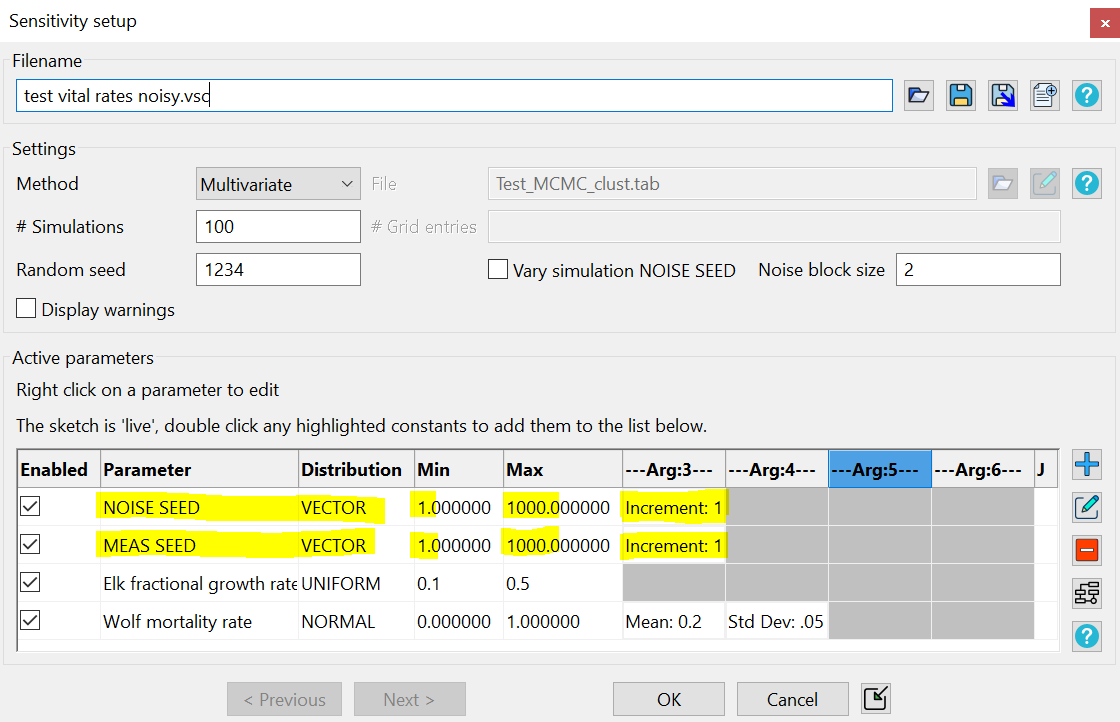
It's also possible to use RANDOM UNIFORM(0,X) where x is large compared to the sample size, e.g., 1 million. (You can actually use any range you wish here but increasing the range will not improve the randomness character because of floating point to integer conversion issues.)
Varying NOISE SEED via checkbox
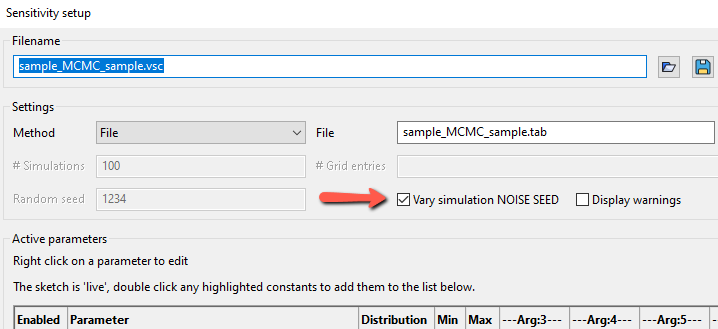
As of v10.3, you can vary the NOISE SEED variable via a checkbox, rather than specifying a VECTOR distribution. This variation is additional to any parameter variation from the input file or parameter list specifications.
Stratification of NOISE SEED
As of v10.5, you can stratify the sampling of NOISE SEED, so that multiple values of NOISE SEED are tested for each sample of the other parameters specified. This may yield lower noise when comparing differences across samples.
You can specify this by setting Noise block size > 1. In the example below, 2 values of NOISE SEED will be tested for each sample in Test_MCMC_clust.tab.
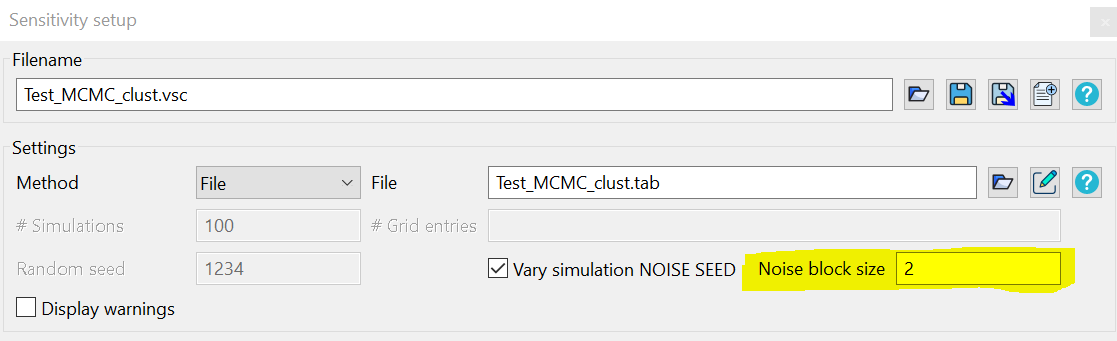
Typically a useful block size will be much greater than 2, but note that this increases the size of the sample to (# Simulations) x (Noise block size), so in this case the size of the experiment is already doubled.